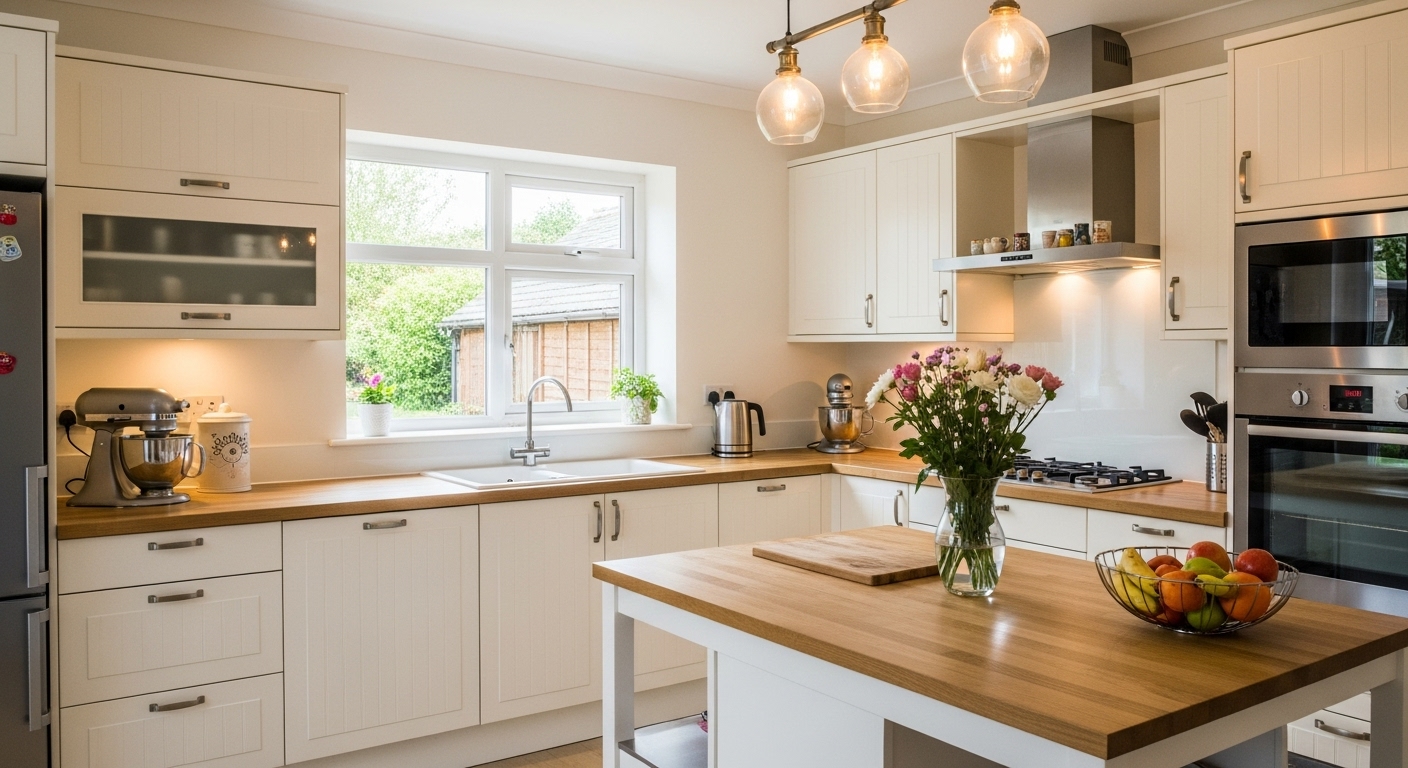
A kitchen counter can look clean and “styled” without being empty. The trick is to stop treating the counter like one big surface and start treating it like three purpose-driven zones.
This method keeps your kitchen functional and photo-ready—without forcing you to hide everything every day.
Why Counters Get Cluttered (Even in “Organized” Homes)
Counter clutter usually isn’t random—it’s predictable:
- Items collect where you cook (oil, salt, utensils, boards)
- Items collect where you fuel up (coffee/tea, mugs, pods)
- Items collect where you arrive (keys, mail, bags, chargers)
So instead of fighting it, we assign a spot for each category so it looks intentional.
The 3-Zone Method (Simple Overview)
Zone 1: Cooking Zone
Everything you actually use while cooking—kept tight and controlled.
Zone 2: Coffee Zone
Your daily beverage setup—styled like a mini station.
Zone 3: Drop Zone
A small “landing strip” for everyday life—so it doesn’t spill across the kitchen.
You don’t need all three if your kitchen is tiny. But even in small kitchens, separating cooking + drop changes everything.
Step 1: Reset the Counter (So You’re Not Styling Over Chaos)
Before zoning, do a quick reset:
- Remove everything from the counter.
- Wipe it down.
- Put back only what you use weekly or daily.
Rule of thumb: If you only use it once a month, it does not deserve permanent counter space.
Zone 1: Cooking Zone (The “Controlled Workbench”)
What belongs here
- Salt + pepper (or one salt cellar)
- Cooking oil (only the one you use most)
- Utensil crock (only daily tools)
- Cutting board (1–2 max, stored upright if possible)
The styling trick: the “One Tray Rule”
Put cooking essentials on one tray or in one container group so it looks curated—not scattered.
Why it works: A tray creates a visual boundary. Even if you have the same items, it looks 10× cleaner.
Keep it clutter-proof
- Limit yourself to 5–7 items visible in the cooking zone.
- Keep the zone near the stove/prep area, not spread across the whole counter.
- Leave at least one clear prep strip. A kitchen that looks expensive always has some open space.
Zone 2: Coffee Zone (The “Mini Café” Setup)
What belongs here
- Coffee maker / kettle (only if you truly use it daily)
- Mugs (ideally 2–4, not your entire collection)
- Sugar/sweetener, stirrers, tea bags (contained neatly)
- A small jar or container for pods/filters (if needed)
The styling formula that always looks good
Machine + one container + one “warm” element
Examples:
- Coffee maker + canister + small plant
- Kettle + tea jar + wood board
- Espresso machine + mug stack + framed print
Why it works: You’re giving the eye a simple, balanced “scene,” not a pile of stuff.
Make it feel calm (not busy)
- Keep packaging hidden (no boxes on the counter)
- Stick to one color palette for the zone (all white, all black, wood + cream, etc.)
- If you have cables, route them behind the machine so they don’t ruin the look
Zone 3: Drop Zone (The “Life Happens Here” Boundary)
This is the zone that saves your entire kitchen.
What belongs here
- Keys
- Wallet
- Sunglasses
- Small chargers (optional)
The hard rule
The drop zone must be small—or it becomes the entire counter.
The easiest setup
- One bowl or tray for keys + small items
- One vertical holder (or standing file) for mail/papers
- One rule: nothing stays longer than 48 hours
Why it works: Drop clutter is inevitable. A dedicated landing spot keeps it from spreading.
The “Looks Expensive” Checklist (5 Fast Rules)
1) Keep surfaces at least 60–70% clear
You don’t need empty counters—just breathing room.
2) Group items in odd numbers (3 or 5)
A set of 3 items looks intentional. A random 4 looks accidental.
3) Limit “open packaging”
Visible boxes and branded bags instantly make a kitchen feel messy.
4) Repeat materials
Repeating wood, white, black, or glass across zones makes everything look cohesive.
5) Use vertical storage where possible
Standing items (boards, paper holders) take less space and look cleaner.
Common Mistakes (And Fixes)
Mistake: You’re styling every corner
Fix: Style only the zones. Leave the rest open.
Mistake: Too many small items scattered
Fix: Consolidate with one tray/container per zone.
Mistake: The coffee zone becomes storage
Fix: Keep only daily items; move backups elsewhere.
Mistake: Drop zone takes over
Fix: Shrink it. One tray. One mail slot. Done.
Real-Life Example (Easy to Copy)
If you want a simple setup that works in most kitchens:
- Cooking Zone: tray with oil + salt + utensil crock
- Coffee Zone: coffee machine + 2 mugs + one canister
- Drop Zone: small bowl for keys + slim paper holder for mail
That’s it. Three zones, no chaos.
FAQ (SEO-Friendly)
How do I keep kitchen counters clutter-free long term?
Create zones and use trays/containers as boundaries. Then maintain a simple rule: only daily-use items stay out.
What should be kept on the counter?
Only what you use daily or weekly—plus a small styled element per zone. Everything else goes in cabinets.
What’s the best way to style a small kitchen counter?
Use fewer zones (usually cooking + coffee) and keep each zone contained to one tray or grouped area.